A new publication from our ECS4DRES consortium has appeared in IEEE Transactions on Industrial Informatics: “Cyber Resilient Communication Network Design for Secondary Control of Microgrids”
As power systems evolve into cyber–physical systems, global coordination increasingly depends on communication-enabled secondary control for voltage and power control. This also creates a critical vulnerability: cyber attacks can propagate through the communication layer into physical dynamics, driving power imbalance and loss of system-wide coordination.
The paper closes a key gap by shifting resilience from post-attack detection or controller patching to planning-stage, attack-aware communication topology design. The authors:
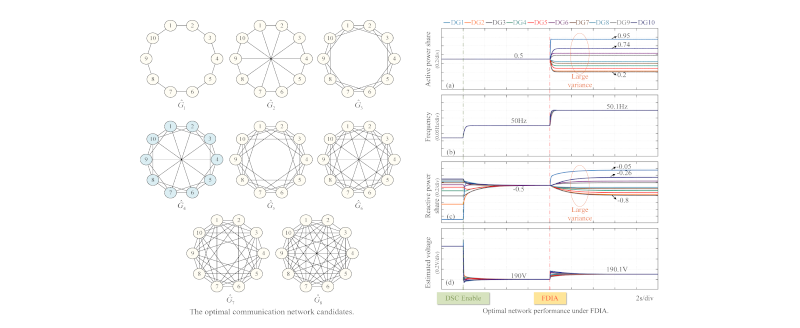
- quantify how FDIA propagates over the communication graph and manifests as measurable power-sharing distortion—making attack impact explicitly topology-dependent and designable
- establish a unified quantitative metric framework spanning DoS, FDIA, and MDA.
- deliver a deployable multi-objective design by co-optimizing resilience metrics with convergence rate, delay robustness, and communication cost
Results show that under FDIA, conventional topologies can severely distort proportional sharing, while the proposed topology substantially suppresses this distortion and keeps units close to nominal operating levels. Under MDA, baseline networks fragment into information islands, whereas the proposed design preserves a dominant connected component so that most surviving units remain coordinated.
This work highlights that resilience can be engineered at the planning stage, with the communication graph serving as an actionable design lever for cyber–physical stability.
Congratulations to the authors: Junjie Xiao, Lu Wang, Qobad Shafiee, Pavol Bauer, and Zian Qin.